
Slab leak water damage in Fort Worth, TX
A slab leak in Fort Worth is a break in a water line under the concrete foundation. A licensed plumber finds and repairs the pipe. The water damage side is separate: pulling up wet flooring and baseboards, extracting water, and drying the slab and walls, which often starts once the leak is stopped.
Your call is connected with an independent local water damage company, chosen by a call network; ask what it handles before work starts. For the leak itself, call a plumber first; this line is for the water damage it leaves. Water category: category 1 (clean water) from a supply line; a slab drain leak is category 2 or 3.
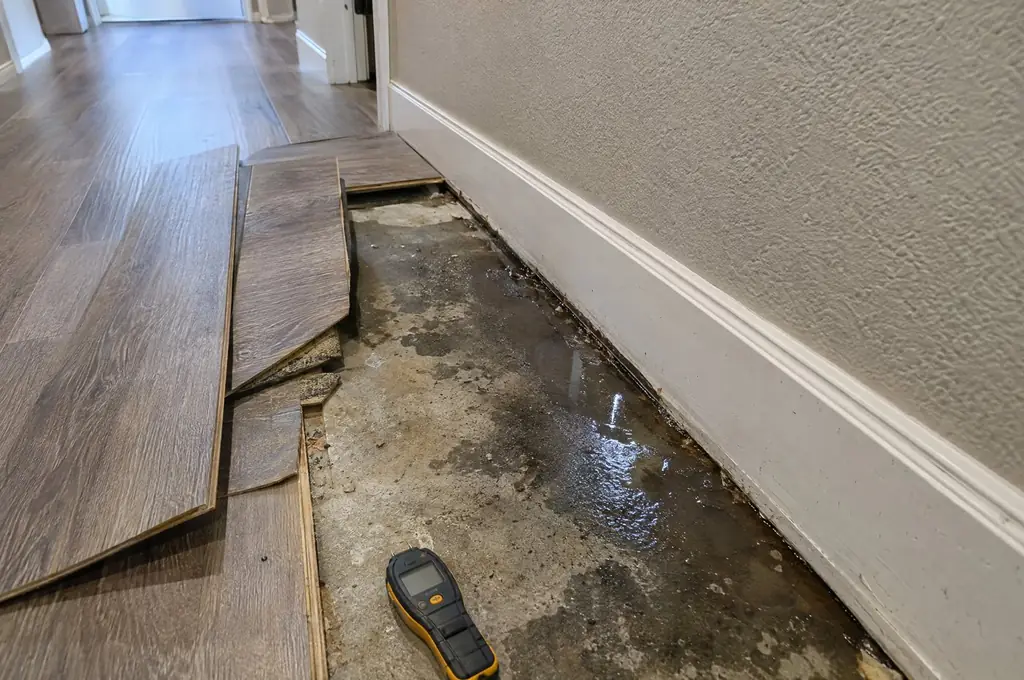
Fort Worth Water owns the line from its main through the meter in the yard box; everything from the meter to the house, and every pipe under the slab, belongs to the owner. So the first call for a suspected slab leak is a plumber, and the second is for drying.
Right now
- 1Close the house shutoff valve, or the valve at the meter box if you can't find one at the house.
- 2If the floor feels warm, the leak is likely on a hot line: turn off the water heater's gas or breaker too.
- 3Watch the meter with every tap off. If the dial still moves, water is escaping somewhere.
- 4Pull back wet rugs and move furniture off damp flooring.
- 5Take dated photos of the wet floor and baseboards for your own records before anything is removed.
Fort Worth and Texas facts for this problem
Fort Worth Water owns the service line from its main up to and including the meter; the property owner is responsible for the pipe from the meter to where it enters the building.
Source: City of Fort Worth: Service line inventory (who owns which part of the line).
Fort Worth Water takes water emergencies 24 hours a day at 817-392-4477, option 1.
Source: City of Fort Worth: Water department (contact and emergencies).
TDI says most home policies cover sudden, accidental water damage but not damage from gradual leaks or seepage, which is how a long-running slab leak is often treated.
Source: When are water damage and mold covered by insurance? (Texas Department of Insurance).
About 39% of the homes in the 26 ZIP codes mostly inside Fort Worth city limits were built before 1980, according to Census estimates for ACS 5-year 2020-2024.
Source: U.S. Census Bureau, ACS 5-year, tables B25034 and B25035, calculated by Fort Worth Water Damage & Mold on November 13, 2026.
The median home in ZIP 76164 was built in 1942, the oldest median among the Fort Worth ZIPs on this site; in 76177 it is 2013 (Census ACS 5-year).
Source: U.S. Census Bureau, ACS 5-year, tables B25034 and B25035, calculated by Fort Worth Water Damage & Mold on November 13, 2026.
The city's service line page splits ownership at the meter: Fort Worth Water from the main to the meter, the owner from the meter to the house. A leak under the slab sits entirely on the owner's side, so a licensed plumber finds and fixes it before drying starts.
Sources: City of Fort Worth: Service line inventory (who owns which part of the line)
Related on this site: the printable emergency checklist for where the shutoffs are and who owns which pipe, and the flood map by ZIP for the median year built in your ZIP.
How the work usually goes
1.Leak located and repaired
A licensed plumber pins down the leak with listening and pressure tests, then repairs it through the slab, under it, or by rerouting the line through walls or the attic.
You: Get the plumber's written description of where the leak was and how it was fixed.
2.Moisture mapping
Meters and a thermal camera show how far water traveled under flooring and into walls, which is often farther than the visible wet spot.
You: Ask for a sketch or photos of the wet area.
3.Flooring and baseboards
Carpet pad usually comes out; laminate and engineered wood often have to be lifted to let the slab dry. Baseboards come off so walls can breathe.
You: Ask which flooring can be saved and which can't.
4.Drying the slab
Air movers and dehumidifiers run until the concrete and wall readings reach dry. Concrete gives up water slowly, so this stage takes longer than drying drywall.
You: Keep the AC on and doors to the drying area shut.
5.Repairs
New flooring goes down only after the slab tests dry, usually under a separate estimate.
You: Keep the moisture logs for whoever installs the new floor.
How insurance usually treats it
Policies often treat the leak and the damage differently. Getting to the pipe and drying what it soaked may be handled apart from replacing the pipe itself, and TDI notes that most home policies don't cover damage from gradual leaks or seepage. A slab leak that ran for months can fall under that exclusion, so the policy wording decides.
General information, not insurance advice; the policy itself decides. More on the Fort Worth water damage insurance page.
What changes the size of the job
- How long the leak ran before it was found, and how far the water spread under flooring
- The type of flooring: carpet, laminate, engineered wood or tile
- Whether the plumber went through the slab inside the house or rerouted the line
- How many rooms and walls need drying
- How long the concrete takes to test dry
No prices on this site. A company measures moisture on site and writes an itemized estimate; the water damage estimator lists what that estimate should include.
Questions people ask about slab leaks
Who pays to fix a slab leak in Fort Worth, the city or me?
The owner. Fort Worth Water owns the line up to and including the meter; the pipe from the meter to the house, and everything under the slab, is the owner's to repair through a licensed plumber.
How can I tell if my Fort Worth house has a slab leak?
Common signs are a warm spot on a tile or concrete floor, the sound of running water with every fixture off, a meter that keeps moving, and damp carpet or swollen baseboards with no leak in sight. A plumber confirms it with pressure and listening tests.
Can a slab leak cause mold?
Yes, if flooring and baseboards stay wet. Carpet pad and the bottom edge of drywall hold water against the slab, which is why they usually come out early in the job.